
Theoretical study of ultrafast laser-induced chiral flip of achiral molecules and its quantitative description
Chirality of molecules is an important topic in biology, chemistry and physics, and the concept is commonly used for enantiomers in the static state. The main focus of this research direction is to extend chirality to molecules in non-static states, and it has been found that non-chiral molecules have chiral behaviors in their electron densities under the excitation of two beams of circularly polarized laser pulses, and chiral flip-flopping occurs on femtosecond to attosecond time scales.
The main research results of our group under this research direction are as follows:
1. The study of the ultrafast kinetic behavior of electrons in non-chiral molecules by taking NaK molecule as an example. The study is carried out by means of numerical simulations of quantum dynamics. By taking into account the electron dynamics and nuclear motion, a general method that can be used to study ultrafast laser-induced charge migration in molecules is proposed. First, the structure of the heteronuclear diatomic molecule NaK is optimized in MOLPRO using the pseudopotential basis group using the complete active space self-consistent field method (CASSCF) to obtain important data such as stable geometrical configurations, electronic state energies, electronic state wavefunctions, and the leptonic dipole moments. Afterwards, the molecule is prepared onto a superposition of three electronic states by designing two circularly polarized laser pulses with the same (+, +) or opposite (+, -) polarization, and the induction of the laser pulses breaks the symmetry of the electron distribution and makes the electron density chiral, and the ultrafast chiral flip of the electron density occurs in femtosecond and attosecond time domains, as obtained by numerical simulations.
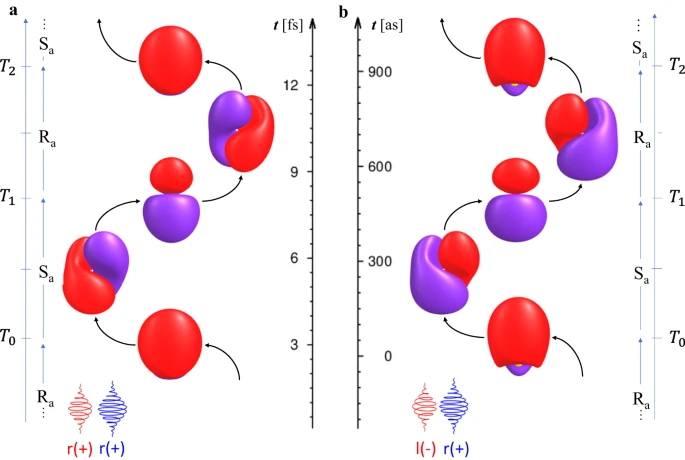
In addition, the effect of atomic nucleus motion on the charge migration mechanism of NaK molecules is also investigated, and the frequency, simple orthonormal coordinates of the ground state and the structure of the excited state are obtained by quantum chemistry software. By studying this model, the chiral flip on femtosecond or attosecond time scales in non-chiral molecules is obtained, which will provide important theoretical guidance and experimental design solutions for the development of the next-generation attosecond switching devices.
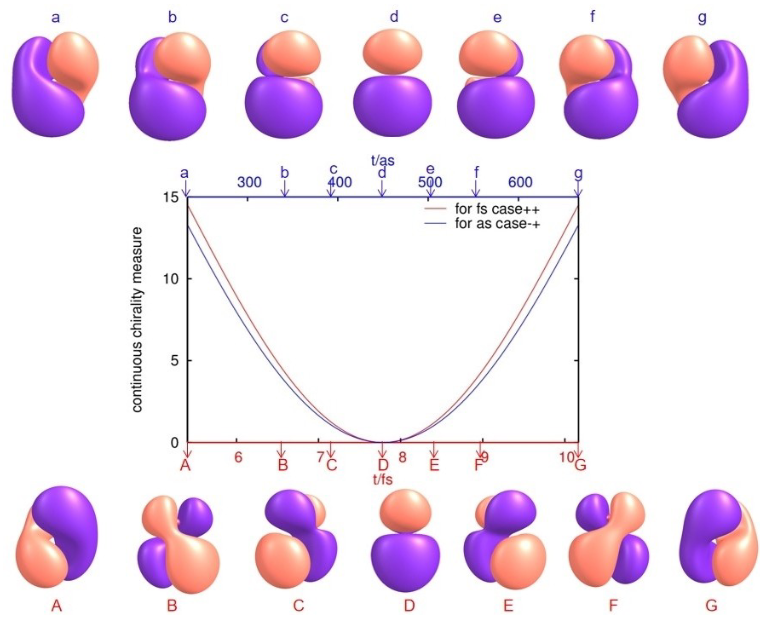
2. Grimme's continuous chirality measurement (CCM) is generally used to measure the chirality of the normalized electronic eigenstate wavefunctions of chiral or achiral molecules that are in the electronic ground state, and from this, to compare the chirality of the electronic wavefunctions of the ground states of different molecules, e.g., the CCMs of alanine, hydrogen peroxide, and achiral molecules are 14.5, 1.2, and 0.0, respectively.In this paper, we extend the CCM to explain the chiral changes of NaK molecules in the chirality with time during chiral flip between opposite electronic wave function enantiomers. In this study, we investigate the ultrafast dynamics of NaK molecules by quantum dynamics simulations to obtain the electron density of the molecules under different cases of laser induction and measure the chirality of the molecule's electron density by using the extended CCM(t). Firstly, the structure of NaK molecule is optimized by Molpro software using pseudopotential basis set to obtain the data of energy and wave function of the molecule under the optimal structure. Secondly, two circularly polarized laser beams are then applied to the molecule to excite the chiral-free NaK molecule from the electronic ground state to the time-containing chiral superposition state, and to flip the chirality of its electron density in the femtosecond or even the attosecond time domain. Finally, Grimme's CCM is extended to CCM(t) and used to measure the chirality of NaK molecules during chiral flip in femtosecond and attosecond time domains. The CCM(t) for the opposite electron enantiomers of the molecule changed from 14.5% or 13.3% to 0.0% and then returned to 14.5% or 13.3% in the 4.76fs and 433as ranges, respectively. The expanded CCM(t) can be used to predict the efficient preparation of electronic superposition states in a given molecule in preparation for selective modulation of chiral-induced spin selection.
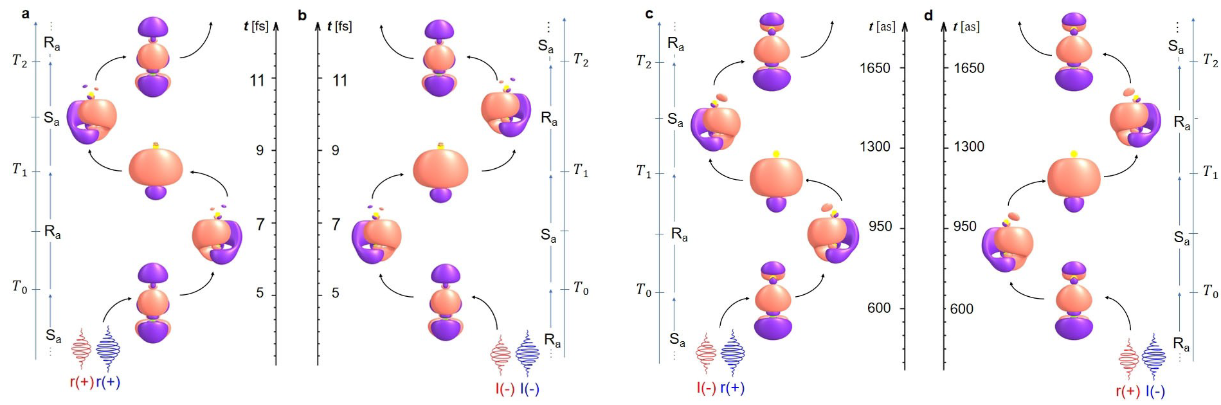
3. The spatio-temporal symmetry of the electron chiral flip of RbCs molecules induced by two synchronized circularly polarized laser pulses in four different combinations (++, -+, +-, ---) was investigated. Firstly, the potentials, jump dipole distances and corresponding wave functions of the ground and excited states of the RbCs molecules were scanned and calculated by selecting the appropriate active space in MOLPRO using the CASSCF method as well as the CC-PVQZ-PP basis set. After that, four different combinations of two circularly polarized laser pulses were designed to prepare the molecule to a superposition of three electronic states, and the induction of the laser pulses breaks the symmetry of the electron distribution, which makes the electron density chiral and undergoes a periodic chiral flip. In addition full quantum dynamics simulations of the time evolution of the wave packet on the potential energy curve estimate the decoherence time of the target superposition state, verifying the applicability of the fixed-core approximation.
By comparison, it is found that ++ and -- and +- and -+ combinations produce opposite electron density enantiomers. This is due to the fact that the laser pulses of the ++ and --- combinations carry photons with opposite angular momentum (