

Laser-induced chiral flipping of chiral molecules
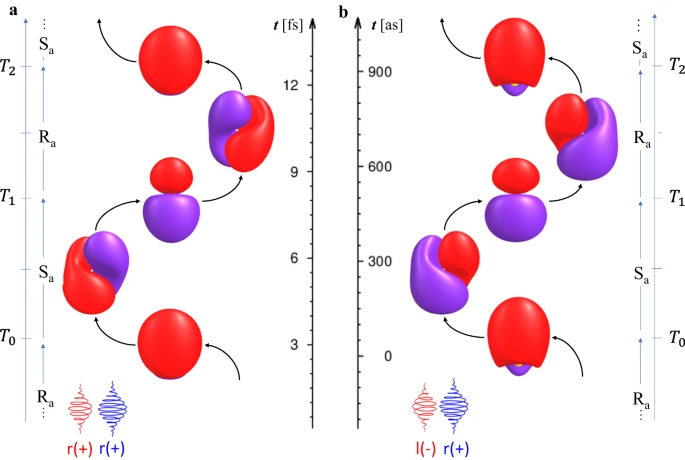
The chirality of molecules is an important topic in biology, chemistry and physics. This concept is often applied to static enantiomers. In this paper, chirality is extended to non-static molecules. It is found that the electron density of achiral molecules exhibits chiral behavior when excited by two circularly polarized laser pulses, and chirality inversion occurs on the femtosecond to attosecond time scale.
This study takes the NaK molecule as an example to investigate the ultrafast dynamics of electrons in non-chiral molecules. The research is conducted through quantum dynamics numerical simulation, considering both electronic dynamics and nuclear motion, and proposes a general method for studying ultrafast laser-induced charge transfer in molecules. Firstly, the structure of the heteronuclear diatomic molecule NaK is optimized using the complete active space self-consistent field (CASSCF) method in MOLPRO with a pseudopotential basis set, obtaining important data such as the stable geometric configuration, electronic state energies, electronic state wave functions, and transition dipole moments. Then, by designing two circularly polarized laser pulses with the same (+,+) or opposite (+,-) polarizations, the molecule is prepared in a superposition state of three electronic states. The induced laser pulses break the symmetry of the electron distribution, making the electron density chiral. Through numerical simulation, ultrafast chiral inversion of the electron density in the femtosecond and attosecond time domains is obtained.
In addition, the influence of nuclear motion on the charge transfer mechanism of NaK molecules was investigated. The frequencies, normal coordinates of the ground state and the structures of the excited states were obtained by quantum chemical software. Considering the nuclear vibration and solving the Schrödinger equation by full quantum numerical simulation, it was found that the nuclear vibration would not cause the decoherence of charge transfer within 20 fs, and the decoherence time was greater than 20 fs. Through the study of this model, the chiral inversion generated in non-chiral molecules on the femtosecond or attosecond time scale will provide important theoretical guidance and experimental design schemes for the development of the next generation of attosecond switch devices.
Key words: Molecular quantum dynamics; Chiral inversion; Ultrafast charge transfer Electron density


Article link:https://doi.org/10.1038/s41467-024-44807-0