

An efficient method for coupled rotation and torsion of oriented AXn1–BYn2 molecules with application to BF2BCl2
The dynamics of molecules often involve coupled rotational and torsional motions, which are computationally expensive and complex to describe using traditional methods. This study aims to develop an efficient approach to accurately characterize such coupled motions in molecules such as BF₂BCl₂. Our research group proposes a novel method for solving a two-dimensional rotation-torsion Hamiltonian by introducing symmetry operations and boundary conditions, which decomposes the problem into multiple independent subspaces, significantly reducing computational complexity. This approach is not only efficient but also yields quantum numbers with clear physical interpretations.
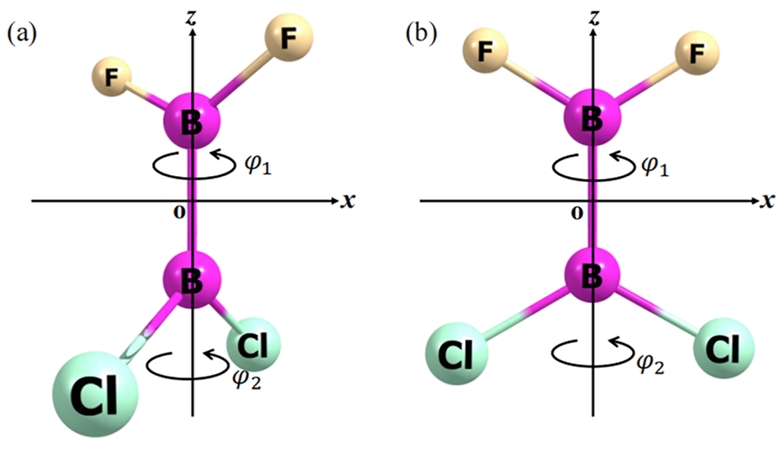
Using BF₂BCl₂ as an example, we computed the energies and wavefunctions of its lowest 1000 rotation-torsion eigenstates. The results demonstrate excellent agreement with those obtained from conventional methods, while the computational efficiency is greatly improved, particularly for high-dimensional problems. The computational time of the new method scales cubically with the parameter mmax, compared to a sixth-power scaling in traditional approaches. For instance, when mmax=100, the new method is approximately 90,000 times faster, leading to substantial savings in computational resources.This methodology provides an efficient tool for studying the dynamics of complex molecular systems, with applications in spectral analysis, reaction kinetics, and theoretical foundations for laser-controlled molecular torsional motion. In the future, this approach can be extended to other AXₙ₁–BYₙ₂-type molecules to further explore its applications in molecular dynamics and quantum control. By combining theoretical innovation and efficient algorithms, this work addresses the computational challenges in modeling coupled rotation-torsion motions and offers a valuable tool for related research.
The published paper:
Huihui Wang, Hongjuan Yang, Changyong Li, Lirong Wang, Yonggang Yang*
Journal of Chemical Physics (2025)162, 244118